
Where have you set your anger dial?
As human beings, we often feel the full range of emotions. Sometimes, all in one moment. We can feel joy and sorrow. We can feel calm and collected. Other times, full of fury and anger.
One thread throughout the rabbinic tradition seeks to guide us on a path of balance and growth. Many centuries after the Talmud, Maimonides discusses this as the middle disposition (deah beinonit), a central path between the extremes, never straying too far into one feeling or its opposite.
The root of some of this thinking comes from texts like this one from Pirkei Avot 5:11:
There are four kinds of dispositions:
Easy to anger and easy to be appeased: their reward goes out with their loss.
Hard to anger and hard to be appeased: their loss goes out with their reward.
Hard to anger and easy to be appeased: this is a pious (hasid) person.
Easy to anger and hard to be appeased: this is a wicked (rasha) person.
In this text, we can reflect on our anger and when that anger is appeased by the person who angered us.
We get two axes: easy and hard vs. anger and appeasement. You can visualize it like this.
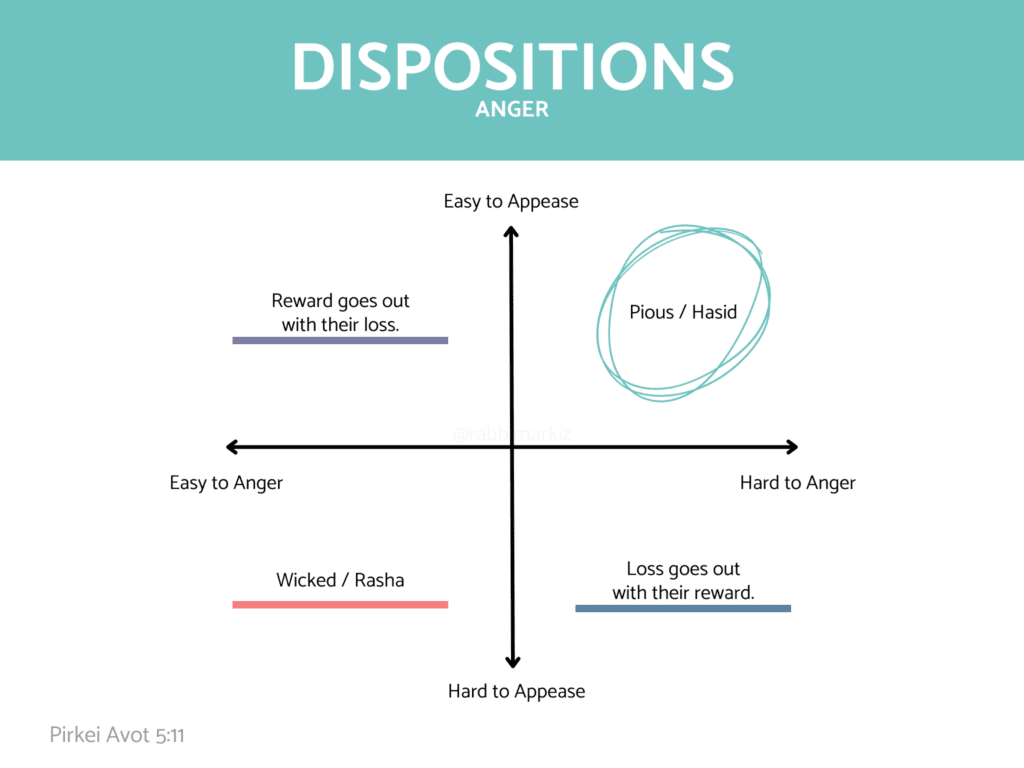
If we are easy to appease and easy to anger, the reward we get from being easy to appease is negated by how easy it is for us to get angry. The opposite can also be true: It is hard to anger us, but it is also hard to resolve the anger, so whatever loss we might have experienced is negated by that positive attribute.
If we are easy to anger but difficult to appease, the rabbis describe this person as wicked, as a rasha. And on some level, this makes sense. This person would be extremely difficult to spend any time with, constantly getting angry but never giving it up or being open to resolution.
Our final category is the one that the rabbis want to guide us toward: difficult to anger but easy to appease.
We can understand why the rabbis want us to be here. We would be calm, a rock of a person, letting whatever is happening flow past us, letting go of the anger we might feel.
This person is described as a hasid, as a pious person, but that scratches the surface of what the rabbis mean.
Hasid comes from the root, hesed, meaning loving-kindness. This person understands themselves, consistently deepens their relationship with the Divine, and succeeds in being their best selves.
In alignment with the beinoni described by the Rambam, who seeks the middle path avoiding extremes, the rabbis of the Mishnah here encourage us to find our emotional center line. Not to ignore our feelings, but not to let them control us.
Two important takeaways arise from this:
- We are still allowed to feel things.
- Letting go, and finding our center is a pathway toward peace.
When we see these feelings bubble up, we can use this text as a reminder. To recognize that it is ok to feel, but that it is also in our best interest to find a path to letting it go.